
Claude Code vs OpenCode: Free vs Paid, Same Prompt Test

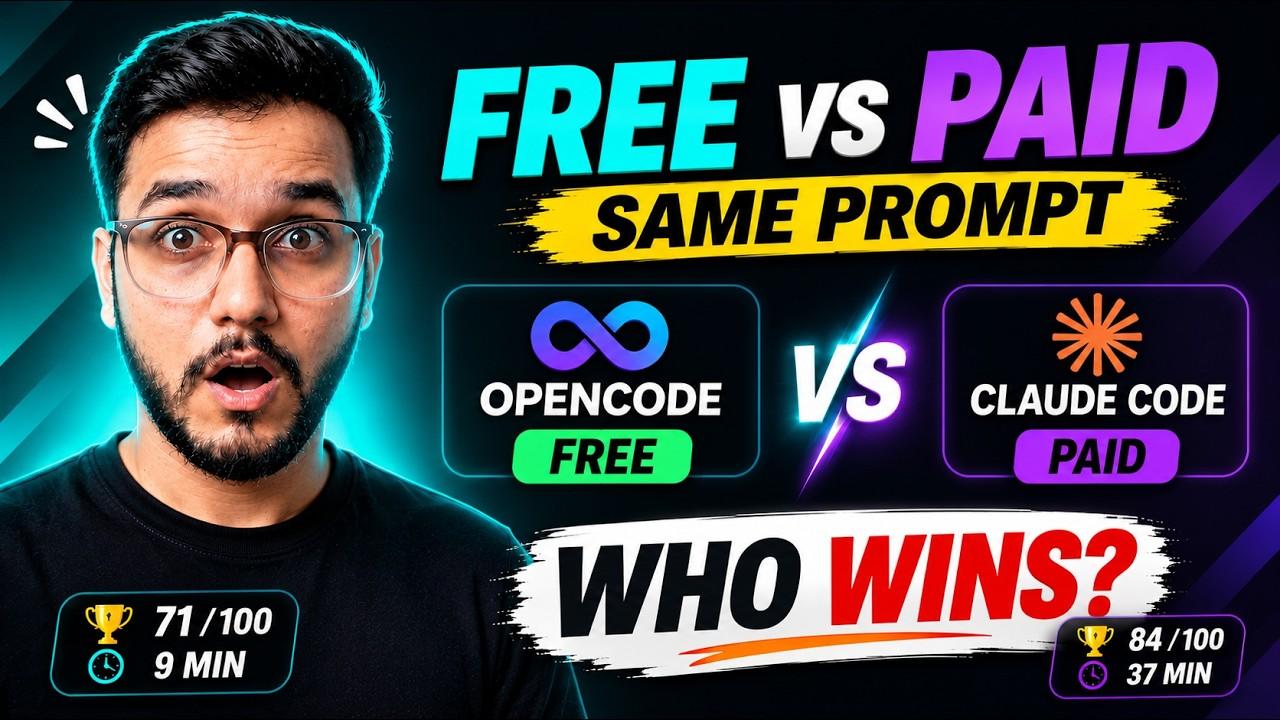
I gave paid Claude Code (Sonnet 5.5) and free OpenCode (DeepSeek V4.1 Flash) the same one-shot prompt to rebuild linear.app. Claude Code won 84 to 71: it finished in 9 minutes instead of 37, averaged about 98 on Lighthouse and handled mobile better. OpenCode's clone looked closer to the real site.
// contents
- 0:00 — Free vs paid AI coding agent
- 0:58 — The linear.app clone prompt
- 1:21 — Playwright MCP for both agents
- 1:51 — The 100-point scorecard
- 2:51 — Sonnet 5.5 vs DeepSeek V4.1 Flash
- 3:41 — Starting the timer
- 5:55 — Model cost and speed check
- 8:07 — Time result: 9 vs 37 minutes
- 9:03 — Build check with npm run build
- 10:06 — Code quality: Astro vs Vite and React
- 12:31 — Visual match comparison
- 16:32 — Responsiveness test on devices
- 18:28 — Lighthouse performance test
- 19:50 — Final score: which agent won
New here? A new build-along tutorial lands on the channel every week.
Subscribe on YouTubeClaude Code vs OpenCode, tested the way I trust: one prompt, one timer, one website. I gave paid Claude Code running Sonnet 5.5 and free OpenCode running DeepSeek V4.1 Flash the same one-shot prompt to rebuild linear.app, then scored both out of 100. Claude Code won 84 to 71, but the free agent took one round outright.
The first two parts of this series were about free Claude Code alternatives. This one checks whether the free option actually holds up against the paid original.
Free vs paid AI coding agent
This is not a "how to get it free" post. I have plenty of those. This is my first comparison on the channel, and the question is simple: how close does a free AI coding agent get to a paid one when both get exactly the same job?
I bought Claude Code for this video. In my own daily routine I mostly use OpenCode with free models, so I came in with a bias toward OpenCode, and I tried to keep it out of the scoring.
The linear.app clone prompt
The job was to clone the top of the linear.app homepage in one shot: navbar, hero, the first three content sections and the footer. One prompt, no follow-ups, and the agent was told to work on its own without asking me questions.
The prompt gives the live site as the only reference, with no screenshots attached. If I give screenshots, the agent copies a still picture and misses how things behave. Instead, it tells the agent to open the site itself at 1440px and 375px, take its own screenshots if it has a browser tool, and build everything from scratch. No copied HTML, CSS, fonts or images, no real logos, and CSS or SVG mockups in place of product images.
It also spells out how the result gets graded: visual match at 1440px, responsiveness at 375, 768 and 1440 with a working hamburger menu, Lighthouse performance and accessibility on a production build, code quality, and finishing in one go. The stack was the agent's choice. That Lighthouse line ended up deciding a lot.
Download the exact prompt (prompt.md) and try it with your own agent. It is the file I pasted into both terminals.
Playwright MCP for both agents
To let them look at the real site, I installed Playwright on my machine and connected its MCP server to both Claude Code and OpenCode. MCP is the protocol that lets an agent use an outside tool, here a real browser.
With that, each agent opened its own browser window, scrolled through linear.app, took its own screenshots and built from them. Same tool on both sides, so neither had an advantage there.
The 100-point scorecard
I named the round "Battle of Best" and scored it on five things:
| Category | Points |
|---|---|
| Visual match | 30 |
| Responsiveness | 20 |
| Lighthouse performance | 20 |
| Code quality | 15 |
| Time | 15 |
Highest total wins.
Sonnet 5.5 vs DeepSeek V4.1 Flash
In Claude Code I picked Sonnet 5.5, not Opus or Fable. OpenCode was on a free model, and putting Anthropic's top model against it would have turned this into a mismatch, not a comparison. The fair alternative would have been paid models on both sides, but I was already testing free versus paid, so Sonnet it was.
In OpenCode I used DeepSeek V4.1 Flash free. Out of the free models in OpenCode right now, it is the best one I have used personally. It is a limited-time free model, so check that it is still in the list before you copy this setup.
Starting the timer
I pasted the prompt into both terminals, pressed Enter on both and started the timer. Whenever an agent asked for a permission, I granted it. I paused the recording during the build, because watching two agents type for half an hour is not content.
Both opened their browsers through Playwright right away and started scrolling the site and taking screenshots. Claude Code also spent time on the mobile view to plan the responsive layout.
Model cost and speed check
While OpenCode was still working, I put both models side by side on OpenRouter's comparison page.
The price gap is huge, on input tokens and even more on output tokens. Speed is a different story. Latency was about the same, and throughput was close. When I generated a test response with both, Sonnet took about 20 seconds and DeepSeek about 24. That is what I wanted to see before the scoring: on raw speed, the two models are roughly in the same league, so a big difference in results comes from how the agent works, not from a slow model.
Time result: 9 vs 37 minutes
Claude Code said it was done at 8:58 on the timer. Call it 9 minutes.
OpenCode was not done. It had finished building, then opened its own site in Playwright and started checking it at different screen sizes to see whether it matched. Claude Code never did that step. It built the site and handed it over.
OpenCode finished about 28 minutes later, so roughly 37 minutes in total. Claude Code was about four times faster, and the scores followed that ratio: Claude Code 12, OpenCode 3 out of 15.
Build check with npm run build
Before looking at anything, both projects had to build. I opened a terminal in each folder and ran:
npm run buildBoth builds passed. No round lost here, but a failed build would have been an instant problem.
Code quality: Astro vs Vite and React
The stack choice tells you how each agent read the prompt.
Claude Code chose Astro. Astro outputs plain HTML with almost no JavaScript, which is great for SEO and for Lighthouse. It set up reusable components, proper fonts, and a single page because that is all we asked for. It also left an empty collections folder behind, which is harmless.
OpenCode chose Vite 7 with React 19. Vite makes the production build fast, and it kept dependencies down to React and fonts, which I liked. More dependencies means more to break. Its components were clean and reusable too: header, footer, hero section, icons. It also saved every reference screenshot it took from linear.app, plus the screenshots of its own build from the self-check, all inside the project.
I did not run a full AI code review on either. I looked through both myself. OpenCode got 14 out of 15 here, mainly for how well it organised everything and kept those reference screenshots.
Visual match comparison
I ran both previews side by side, then full screen, and went section by section against the real linear.app.
The Claude Code clone looked close at a glance, but the details slipped. Icons were missing in places, an avatar row was missing, a scroll animation was missing, and the send button in one section was simply not there. I gave it 22 out of 30.
OpenCode's version had its own mistakes. One section that should be centered was aligned left. But the icons were better, it added animations that looked good, and its links at least pointed somewhere instead of looping back to the same page. Both clones handled the light and dark sections properly.
Both had the same big gap: they copied the look from screenshots, not the behaviour. Clicking a tab did not change the UI, buttons were not clickable, and an input field did not accept typing.
OpenCode was slightly better overall, so it got four more: 26 out of 30. This is the round the free agent won, and I think the reason is the Playwright self-check. It compared its own result with the original several times. Claude Code did not.
Responsiveness test on devices
For this round I used a Chrome extension that shows a page on several device sizes at once.
OpenCode looked fine on Pixel 7 Pro and iPhone 14 Pro. Nothing spilled off the screen and the text stayed aligned. On iPad Air 5 one section overflowed. The bigger miss: the hamburger menu button did nothing when I tapped it.
Claude Code's menu opened properly on mobile. It had the same overflow as OpenCode in one spot, but it switched a horizontal row of items to a vertical stack on small screens, where OpenCode just shrank everything.
After seeing both, I cut OpenCode from 18 to 16 and gave Claude Code 19, not 20, because of that one overflow.
Lighthouse performance test
Lighthouse scores move between runs, so I ran each site three times, twice on desktop and once on mobile, and took the average. The Claude Code build was the one on port 4321.
OpenCode scored 54 and 76 on desktop and 27 on mobile. That averages to about 52. Accessibility, best practices and SEO were fine. Performance was the problem.
Claude Code scored in the high 90s on every run, including a 100, for an average of about 98. This is where the Astro decision paid off. It read "Lighthouse" in the prompt and built the whole thing around it. Bhaad mein baaki sab, competition jeetna hai.
Final score: which agent won
| Category | Max | Claude Code | OpenCode |
|---|---|---|---|
| Time | 15 | 12 | 3 |
| Visual match | 30 | 22 | 26 |
| Responsiveness | 20 | 19 | 16 |
| Code quality + Lighthouse | 35 | 31 | 26 |
| Total | 100 | 84 | 71 |
Claude Code won, 84 to 71.
Where Claude Code pulled ahead: time, by a wide margin; mobile layout, because it actually changed the layout instead of shrinking it; and Lighthouse, by a huge margin, thanks to Astro. React would scale better for a bigger app, but the prompt asked for performance and Claude Code built for exactly that.
Where OpenCode won: the visual match. The free DeepSeek model did the frontend details better, and I put that down to the extra Playwright checks.
My take: if you have a strict target like a Lighthouse score and want it in one shot, the paid agent was clearly better here. For everyday coding, a 13-point gap at zero cost is why OpenCode is still the one open on my machine most days.
Previous part of this series: Claude Code alternatives part 2: Kombai and OpenRouter. Want to run OpenCode for free first? Start with the free OpenCode setup, or put several free providers behind one key with the FreeLLMAPI setup.
Every free way to run Claude Code, with limits: six free ways to use Claude Code.
- Same one-shot prompt, same Playwright MCP, same timer: Claude Code 84, OpenCode 71.
- Claude Code (Sonnet 5.5) finished in about 9 minutes; OpenCode (free DeepSeek V4.1 Flash) took about 37.
- OpenCode won visual match 26 to 22 because it re-checked its own build with Playwright.
- Claude Code won mobile layout 19 to 16; OpenCode's hamburger menu did not open.
- Claude Code picked Astro and averaged about 98 on Lighthouse; OpenCode's React build averaged about 52.
- Both clones copied the look from screenshots but missed real functionality like clickable links and a typeable input.
Is OpenCode better than Claude Code?
OpenCode vs Claude Code: which is faster?
Is DeepSeek V4.1 Flash free in OpenCode?
Why did you use Sonnet 5.5 and not Opus or Fable in Claude Code?
Can a free AI coding agent replace Claude Code?
Why did Claude Code choose Astro?
New posts in your inbox
Subscribe to get every tutorial.